

NASA said Tuesday that it has postponed the second mission of its Artemis program, pushing the highly anticipated launch from Feb. 8 into March.
During a wet dress rehearsal of the rocket-towering system at the Kennedy Space Center in Cape Canaveral, Florida, NASA said it had run into delays due to weather and found a leak in the hydrogen tanks.
The mission is the first crewed flight test aboard the Orion spacecraft, which will send four astronauts into deep space on a lunar flyby, marking the first time astronauts have been to the moon since Apollo 17 in 1972.
Artemis II is a stepping stone in NASA’s Artemis campaign, which seeks to establish a long-term presence on the moon and continue research aimed at sending humans to Mars. The program was established in 2019 during President Donald Trump’s first term after he signed Space Policy Directive-1 two years prior. This directive refocused the Obama administration’s policies on “moon first” initiatives.
The Biden administration largely embraced Artemis, keeping it central to U.S. space policy. The program was safeguarded by legislation in 2022, making it politically durable but also subject to oversight. Artemis is funded annually by Congress, where it has strong bipartisan backing, mainly due to the fact that equipment is built across dozens of states.
Named after Apollo’s twin sister in Greek mythology, Artemis is meant to expand on the Apollo missions by planting more than a flag. Artemis will establish a space station, Gateway, to orbit the moon, similar to the International Space Station orbiting Earth. Gateway is a multinational project involving Europe, Canada, the United Arab Emirates, and Japan. The program is paired with the Artemis Accords, a set of nonbinding agreements that outline principles for lunar exploration, resource use, and cooperation.
In contrast to Apollo, Artemis relies heavily on commercial partners to develop spacecraft components, such as Boeing, Lockheed Martin, and Elon Musk’s SpaceX.
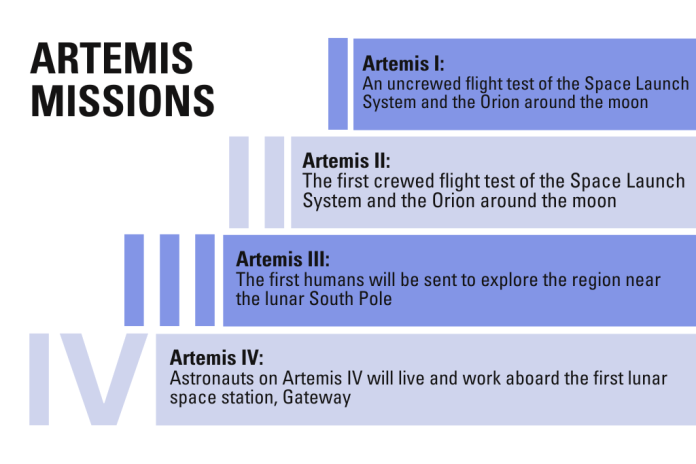
The program’s first major test, Artemis I, launched in 2022. During the 25-day mission, the uncrewed flight test sent Orion around the moon and back to Earth. The mission validated the performance of the Space Launch System, though it revealed problems with the capsule’s heat shield that required further analysis.
Building on this success, Artemis II was originally slated for launch in 2025, but faced significant delays due to funding issues. In 2024, the cost to launch Artemis II was estimated at $4.2 billion.
While NASA champions Artemis II and emphasizes its importance in space exploration, critics argue that the cost is unjustified, especially since many rocket parts end up in the ocean or are lost after missions.
Artemis II will carry its crew on a 10-day lunar flyby to test Orion’s life-support systems and crew interfaces in deep space.
Trump has solidified the program’s missions by signing an executive order to have Americans on the moon by 2028 and establish “initial elements of a permanent lunar outpost” by 2030.
Artemis III is the key step to getting boots on the moon. It was originally planned for 2027, but Trump’s executive order gives a year of wiggle room. Over the course of the 30-day mission, two crew members will descend to the moon’s surface and spend a week near the lunar south pole.
The Biden administration pushed for the first woman and the first person of color to be among the crew to touch down on the moon during the third mission. According to NASA, the four-person crew has not yet been finalized.
HEGSETH TAKES TEST FLIGHT WITH NASA ADMINISTRATOR AS THEY PREPARE FOR ARTEMIS II FLIGHT
Artemis III depends heavily on systems still in development, including the lunar lander being built by SpaceX. NASA has detailed the Artemis program up to stage four, which will mark the crescendo of the return to the moon and establish “superiority in space.”
Astronauts on Artemis IV will live and work aboard the Gateway lunar station, which will be constructed on Earth and sent into space, catching in the moon’s orbit. Development is already underway with Maxar and Northrop Grumman constructing two modules that will connect to the SpaceX rocket. Gateway will serve as a “lunar outpost” for astronauts doing missions on the moon’s surface while advancing exploration “further into the cosmos.”
